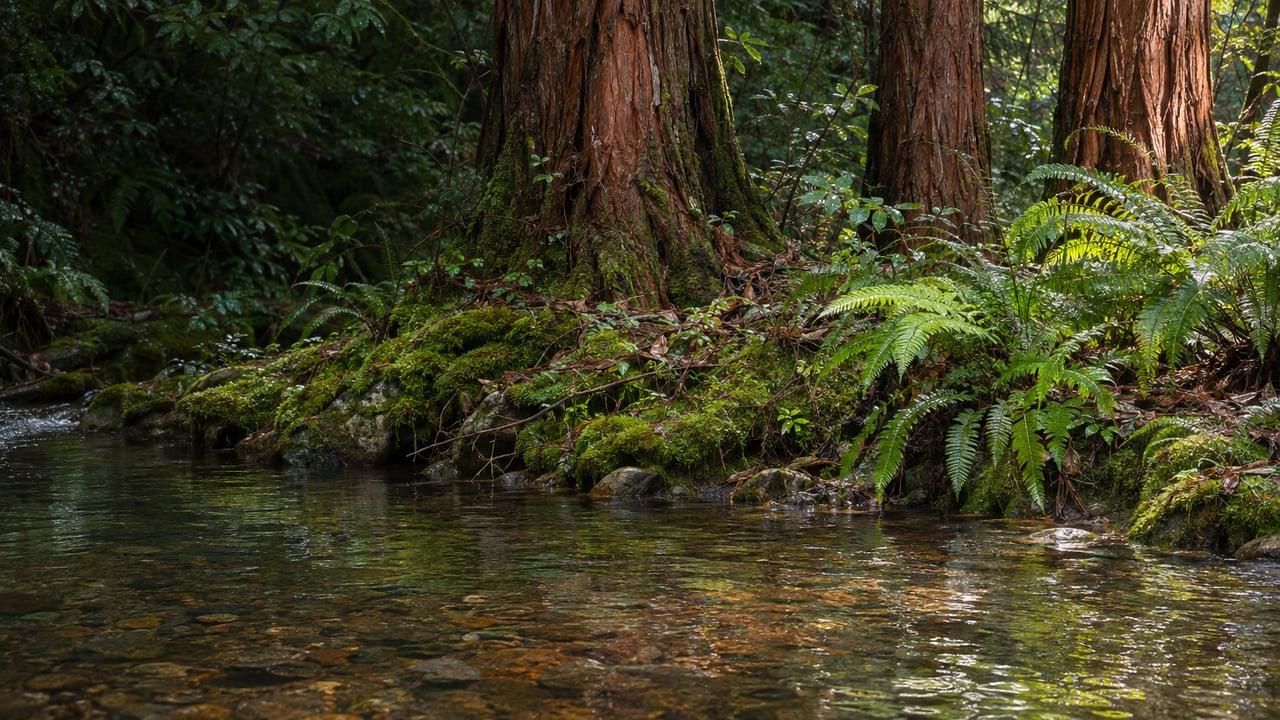
On Tuesday, November 19, 2024, crews worked up Redwood Creek through Muir Woods in teams of four carrying young coho salmon. They placed the fish in deep pools with woody debris for cover, kept each pool connected to the main channel, and spaced the releases far enough apart that the fish could spread out without crowding any one stretch. About 3,000 juveniles went into the creek that day. Each one carried a PIT tag, a small electronic marker that the National Park Service's San Francisco Bay Area Network fish crew had implanted over two weeks in October 2024 at Warm Springs Hatchery near Lake Sonoma.
Coho live on a three-year clock, and that release was timed to it. The NPS wrote that the hatchery fish and the wild fish would come back as three-year-old adults to spawn "during the winter of 2026-2027." That winter's spawning season is weeks away. From the end of a Mill Valley street, the creek where those fish were let go is a short drive down the hill, and this season's walk along it is the first real look at whether the plan worked.
Why 3,000 Fish Went Into a Creek That Had 500
The Park Service did not add hatchery fish to Redwood Creek on a whim. The 2023-24 spawning season had looked promising, with the NPS reporting at least 22 live adult coho and about 20 redds, or salmon nests, in Redwood Creek that winter. That adult count included hatchery fish released alongside the natural returns, and the season's records also list a release of 48 adult coho.
Then came the summer count. When the fish crew snorkeled the creek in July 2024, they found that only around 500 juveniles from those nests had survived to late summer, which the NPS called "far fewer than anticipated" given how many spawners and redds it had seen. With a wild group that small, the Park Service and recovery managers at the California Department of Fish and Wildlife and NOAA's National Marine Fisheries Service decided Redwood Creek needed more juveniles. Warm Springs is a conservation hatchery, and its goal is releases that lead to adults spawning in the wild.
The math is what makes this winter different. Roughly 500 wild survivors and about 3,000 tagged hatchery fish started out in the same creek in late 2024. Whatever share of them makes it back from the ocean is the group expected to spawn under the redwoods over the next few months.
Three Cohorts, Three Very Different Winters
The three-year cycle means Redwood Creek holds three largely separate coho populations, and each one returns every third winter. The NPS describes these cohorts as "mostly independent populations," so a big year can come right before a thin one. The three NPS spawner reports from 2022-23 through 2024-25 show how wide that swing can be on Redwood Creek.
| Spawning season | What NPS surveyors recorded on Redwood Creek |
|---|---|
| 2022-23 | No signs of coho in more than 15 surveys; three live steelhead and one steelhead redd |
| 2023-24 | At least 22 live adult coho, hatchery fish included, and about 20 redds |
| 2024-25 | More than 30 confirmed coho redds, plus Chinook in late November and 14 live steelhead counted on one day in mid-January |
The NPS called the 2024-25 Redwood Creek total "relatively low" given recent hatchery stocking and habitat work. That same winter, Olema Creek in Point Reyes had more than 200 confirmed coho redds. Olema's previous high was 137, set in 2004-05. The fish returning this winter belong to the 2023-24 line, the one that began with about 20 nests and lost most of its young before the hatchery stepped in.
The 2024-25 line had a good summer of its own. Snorkel counts in summer 2025 put the young coho in Redwood Creek at nearly 6,000, and the NPS expected its 2025 juvenile estimates to be the second highest in its monitoring record. Surveyors also found juvenile coho throughout the main channel and in the lower half of Fern Creek, a wider range than they had seen on the creek in recent years. The crew PIT-tagged about 400 of them, and the NPS wrote that if it is lucky, some could return to spawn in winter 2027.
What the Tags Are Meant to Answer
The PIT tags make the 2024 release a research project as well as a rescue. The NPS said it would use the Redwood Creek group to judge whether adding hatchery fish works, and to compare survival with fish from the Russian River Broodstock Program. The agency said what it learns will help decide "whether hatchery augmentation is worth the investment in following years or a new release strategy needs to be employed."
The fish are also returning to a different creek than the one their parents knew. The final phase of the Salmon Habitat Enhancement Project at Muir Woods ran from July to November 2023. Crews took out sections of rock armoring along the banks and placed trees and logs to make slower pools and cover for young coho. Farther downstream at Muir Beach, the Golden Gate National Parks Conservancy's 46-acre Redwood Creek restoration was finished in 2014. It reconnected the floodplain and side channels at the creek mouth and turned the beach parking lot so it no longer blocks the floodplain. Every returning adult swims past that work on its way into the woods.
Walking Redwood Creek in January
The NPS coho viewing guide names January as traditionally the best month to see spawning salmon in West Marin. It also says fish are more likely to show up one to three days after a rainstorm, when higher flows let them move upstream. For Redwood Creek, the directions are to enter Muir Woods and follow the path along the creek. In the 2022-23 surveys across the region, coho were active from mid-December through January. Steelhead can keep spawning into April, so a February or March walk can still turn up fish.
The Main Trail runs beside Redwood Creek from the entrance plaza. Creekside loops turn back at Bridge 2 after half a mile, at Bridge 3 after a mile, and at Bridge 4 after two miles, so a family can choose the walk by how far little legs can go. If you usually come down the Dipsea, the Redwood Creek footbridge on the Dipsea return closes every winter for coho spawning, and the NPS hiking page has current trail conditions. The park's regular ranger programs include "Welcome to the Woods" at Founders Grove daily at 10:15 a.m. and 1:15 p.m.
Getting in takes some planning, even for people who live ten minutes away. The NPS requires advance online reservations for every personal vehicle and every shuttle rider. Ride-shares and taxis don't need a parking reservation, but the park warns there is no cell service for calling a ride home. Winter core hours are 8 a.m. to 5 p.m. daily, and the park can close for bad weather or hazardous conditions. On GoMuirWoods, the authorized reservation site, parking is currently $10 for a standard vehicle, and the shuttle is $4 round trip for adults 16 and up. Children 15 and under ride free. The NPS entrance fee is a separate $15 per adult age 16 and older, and children under 16 get in free. A rainstorm early in the week followed by a dry morning is the window the viewing guide points to, so it makes sense to book once the forecast lines up.
For a second creek, the NPS notes that Marin Water opens the parking area at the Leo T. Cronin Fish Viewing Area on Lagunitas Creek from December through February.
The Bridge on Frank Valley Road
Redwood Creek is also at the center of a road project. On October 20, 2026, the Marin County Board of Supervisors approved the environmental document and the Muir Woods Road Improvement Project, and a Notice of Determination followed on October 26. The project covers the stretch of Muir Woods Road, also called Frank Valley Road, between the monument entrance and Highway 1. The plan includes resurfacing, slope stabilization and replacing the existing bridge over Redwood Creek. The Federal Highway Administration's Central Federal Lands Highway Division is leading it with Marin County Public Works, the National Park Service and California State Parks. The county project page is the place to watch for construction timing.
If this winter goes the way the NPS hoped in 2024, some of the fish spawning under the redwoods in January will be carrying tags put in at Lake Sonoma two Octobers ago. On a weekday after a storm, the half-mile walk to Bridge 2 is enough to see whether they made it.
At The Brody Team, we enjoy trading notes with neighbors on the best quiet mornings in the woods and the trails that start right at the end of the street. If you'd like to talk about Mill Valley's winter rhythms, or what living close to Muir Woods and Mt. Tam looks like day to day, Contact The Brody Team.