Most California sellers meet a home inspector hired by the buyer. Mill Valley sellers meet one more: a city employee, working from a checklist the buyer never sees, whose sign-off is a legal condition of transfer. The inspection costs $389 for a single-family home. What it can cost afterward is the number that matters.
The report is called the Residential Building Report, or RBR, and it is the quiet reason two Mill Valley homes with identical comps can close $150,000 apart. The finish level is not the deal. The permit history is.
"It is unlawful for the owner of a residential building in the City of Mill Valley to sell or exchange the same without first having obtained and delivered to the buyer a report of residential building record." — Mill Valley Municipal Code 20.70.070, on the books since Ordinance 789 in 1973 and reaffirmed by Ordinance 1261 in 2013.
What the city is actually looking for
Private home inspectors are trained to find water damage, corroded shutoffs, and roof issues. The Mill Valley RBR is a different exercise. Per the city's own resale FAQ, the inspector is doing a cursory life-safety and sanitation review, and looking for two specific things beyond that: illegal construction and unpermitted second units.
Translated into plain English, the inspector is asking:
- Was the primary bedroom always the primary bedroom, or did someone convert an unpermitted attic?
- Is that downstairs studio with the kitchenette actually a legal ADU, or a rental someone built quietly in 2011?
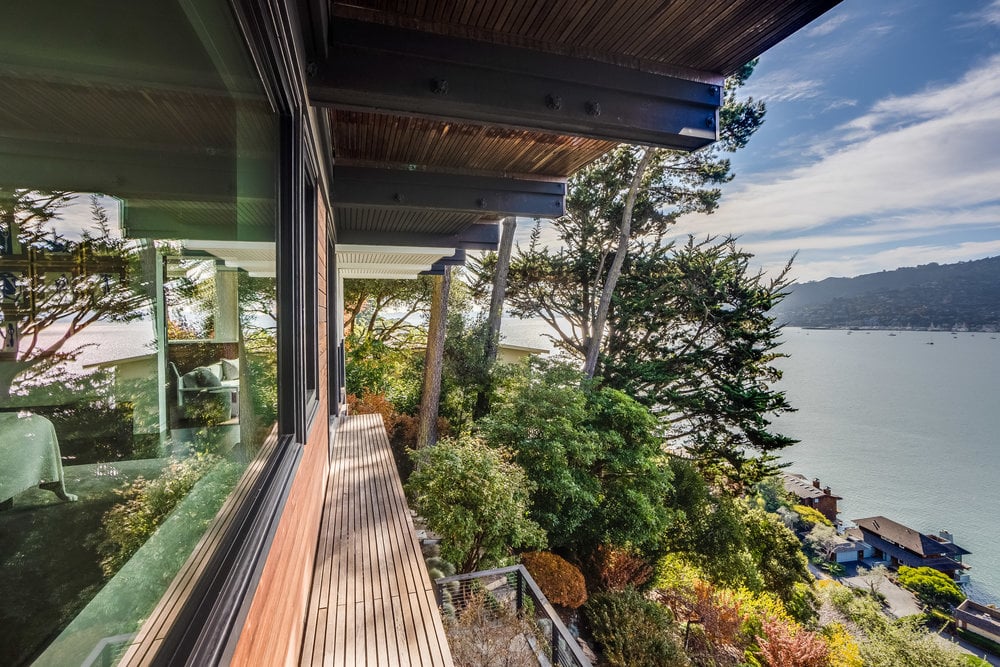
- Did the deck that hangs over the hillside ever pass a final?
- Does the garage conversion have permits, or is it a "family room" that will lose its floor area credit the day the buyer's lender orders an appraisal?
The report is treated as a disclosure. The teeth come from a different sentence on the city's resale page: "All violations are attached to the parcel and remain in effect regardless of changes in ownership." A buyer inheriting a flagged RBR is inheriting a to-do list with the city's name at the top, and every sophisticated Marin buyer's agent knows to price that list into the offer.
Why Mill Valley homes accumulate unpermitted work in the first place
Understanding the RBR requires understanding why so many Mill Valley homes have something on them the RBR can find.
The city caps the size of a single-family home through a Floor Area Ratio applied to what the code calls the effective lot area. The mechanics live in MVMC 20.16.040 and they are unusually strict. Height above natural grade is limited to 25 feet, with a 35-foot allowance only where setbacks are more than doubled. Interior setbacks scale with lot size but never drop below five feet. Adjusted floor area counts enclosed patios, enclosed terraces, and any undeveloped volume larger than eight by ten by seven feet that could theoretically become living space later.
Buried in that section is a rule that quietly shapes the entire market. For any single-family home whose adjusted floor area on May 6, 1991 already exceeded the maximum, or came within 100 square feet of it, the city allows a one-time addition of up to 100 square feet, no variance permitted, available only once per parcel.
Read that again. If your Mill Valley home was already at or near the cap in 1991, the legal expansion available to you for the entire life of the property is one hundred square feet. Ever. Not per decade. Once.
That constraint is the reason so many charming mid-century homes on the hill have a bathroom, a mudroom, or a lower-level suite that does not appear in any permit record. Owners who bought a 1,900-square-foot house that was already at its cap did what people do. They built the addition anyway. The house was worth more with it than without it, and the enforcement mechanism was thirty years in the future.
The RBR is the future arriving.
The 35 percent trap when you try to legalize on the way out
Sellers who find out about an unpermitted addition three weeks before listing often assume the fix is a fast retroactive permit. In Mill Valley, that assumption collides with a second rule.
Per Plan Your Project, design review by the Planning Department is required for any residential addition exceeding 35 percent of existing floor area or 1,000 square feet, and for demolition of 50 percent or more of a dwelling's exterior surface. A 400-square-foot bedroom that someone added to an 1,100-square-foot cottage in 2008 does not just need a building permit today. It needs planning approval, which means design review, which means a public process, which means a schedule measured in months rather than weeks. The same page notes explicitly that a special inspection is required for any home being sold within the City of Mill Valley, so the seller cannot simply hope the work stays hidden.
The economic point is not that legalization is impossible. The point is that legalization on the seller's timeline is often impossible, and Mill Valley buyers know it. A seller who cannot deliver a clean RBR by close either negotiates a credit, extends escrow into a legalization window the buyer's lender may not tolerate, or watches the deal repaper as an as-is with a discount that reflects the buyer's risk premium.
The soft-story ordinance is a separate lane
Because it is often mentioned in the same conversations, worth clarifying: the 2023 seismic retrofit ordinance is not a single-family issue. Ordinance 1343, codified at MVMC Chapter 14.36, applies only to residential buildings built before 1978 with two or more stories, three or more units, and a wood-frame target story. Screening was due by December 15, 2024, and retrofit deadlines run three to six years by tier. If you own a single-family home, this ordinance does not apply to you. If you own a small pre-1978 apartment building in Mill Valley and are thinking about selling, it applies to you before you list, and Revenue and Taxation Code Section 74.5 exempts the retrofit itself from reassessment, which changes the math on doing the work versus discounting for it.
Sequencing this before you list
Every Mill Valley listing benefits from an honest reckoning with the permit file before the sign goes in the ground. A working sequence:
- Pull the parcel's building permit history. The city's online database goes back to roughly November 2012 per the property permit page; older records require a counter visit or a call to Planning & Building.
- Walk the house against the permit record. Every bathroom, every wall, every deck expansion. Note the gaps.
- For gaps that involve an accessory unit, review the ADU legalization path in MVMC 20.90 and the 2026 ADU handout. Existing structures can often be brought into compliance with a limited 150-square-foot footprint expansion for ingress and egress, and the Marin Housing Authority's ADU grant offers up to $50,000 for units rented to low-income tenants on interest-free deferred terms.
- For gaps that trigger the 35 percent design-review threshold, decide early whether to legalize before listing, price the risk into the number, or offer the buyer a credit at close.
- Order the RBR yourself before you list, not after you have an offer. The report costs $389 for the first unit and $89 per additional unit. Knowing what it will say is worth several multiples of that.
The listings that close smoothly in Mill Valley are almost never the ones where the seller had no unpermitted work. They are the ones where the seller knew about the unpermitted work first.
FAQ
Does the RBR expire if my listing sits? The report is tied to the transaction, not a calendar. If your listing goes stale and you relist later against a different buyer, the city may require a fresh inspection to reflect current conditions on the parcel.
Can I sell as-is and skip the report? No. MVMC 20.70.070 makes the sale itself unlawful without an RBR delivered to the buyer. As-is language in the purchase contract governs repair obligations between buyer and seller. It does not override the city's delivery requirement.
If a prior owner did the unpermitted work, am I still responsible? The city treats violations as attached to the parcel. Which owner did the work does not change the current owner's obligation to resolve mandatory items before the sale closes.
Every Mill Valley sale is a negotiation with the city as much as with the buyer, and the sellers who net the strongest prices are the ones who start that negotiation months before the listing photos are shot. If you are weighing a sale in the next twelve months and want a candid read on where your permit history sits against your pricing target, Beth Brody and the Brody Team have spent four decades on exactly this conversation. Contact The Brody Team when you are ready to plan the sale on your terms rather than the report's.